Chair
Strategic Oversight
Chair-level agents aligned work with your core mission, approved high-stakes decisions, and resolved conflicts between competing priorities. They were the guardrails.
Architecture & Capabilities
You submitted a job. Sairgent's delegation engine routed it to the right starting point in your agent hierarchy. From there, work flowed downward through the tree, breaking into subtasks, delegating to specialists, executing in parallel where possible, and flowing deliverables back up the chain.
Every step was visible. Every decision was logged. Every deliverable was traceable back to the agent that produced it and the brief that spawned it.
The Hierarchy Model
Sairgent agents operate in three tiers, modelled on a real organisational structure. This is not a flat pool of tools. It is an organisation.
Chair-level agents aligned work with your core mission, approved high-stakes decisions, and resolved conflicts between competing priorities. They were the guardrails.
Managers received briefs from above, broke them into workstreams, delegated to specialists, and tracked progress. They enforced quality and ensured the value math added up before work shipped.
Specialists had deep capability in a specific domain, code, design, copy, research, security, SEO. They received focused briefs, executed with high fidelity, and delivered back up the chain.
Visual Workspace
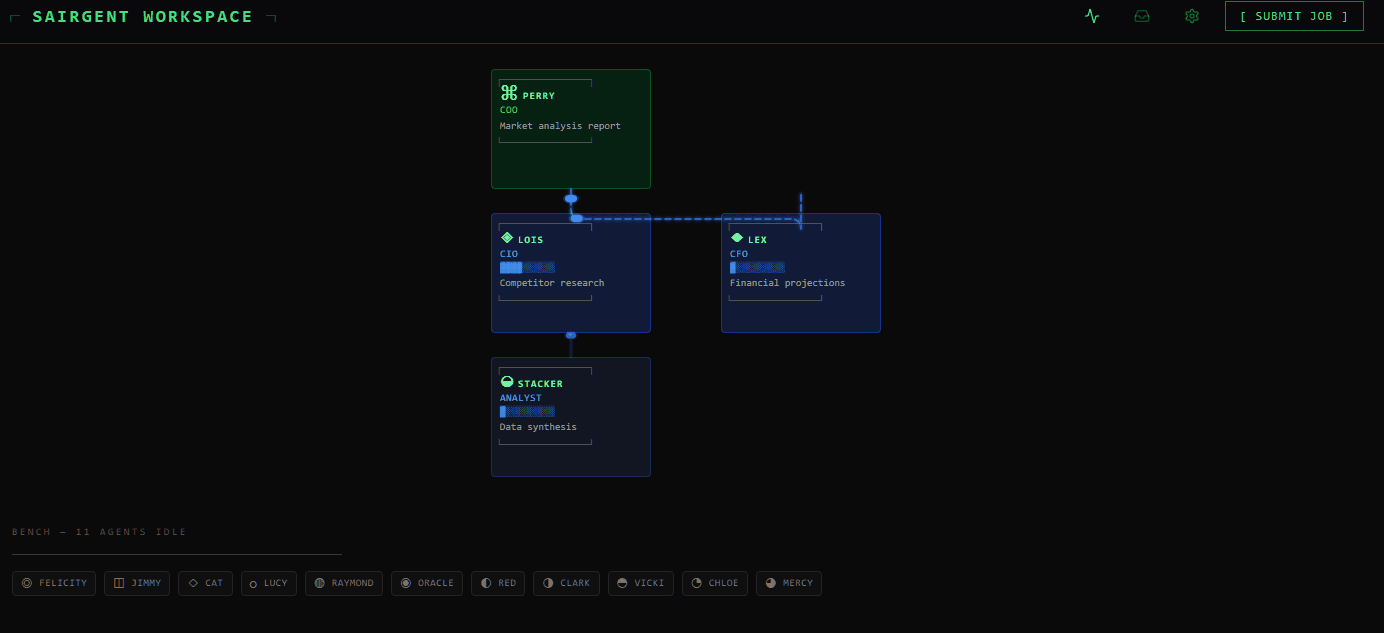
The visual workspace was where Sairgent became tangible. Instead of reading logs or watching a terminal scroll, you saw your agent organisation in a spatial layout.
Each agent appeared as a workstation card showing their name, role, current task, and progress. When an agent received a delegation, their card activated. Connection paths animated between agents as work flowed through the tree.
The bench at the bottom of the workspace showed your idle agents, ready for assignment. Active paths were colour-coded: blue for in-progress, green for complete, red for blocked, purple for review.
Persistent Memory
Context rot is real. Long conversations degrade like photocopies of photocopies. Most agent frameworks start every session from scratch, losing everything learned in previous runs.
Sairgent maintained a persistent memory layer. Agents carried context across sessions, decisions made, preferences learned, patterns observed. Your AI organisation remembered what happened yesterday and built on it today.
Audit Trail
Every delegation, every decision, every deliverable was logged in a structured audit trail. You could trace any output back through the delegation chain to the original brief.
This was not optional observability bolted on after the fact. The audit trail was a core architectural component. Governance was part of the product, not an afterthought.
Event Bus
Sairgent's real-time event bus broadcast agent activity as it happened. The visual workspace subscribed to it. Your monitoring tools could too. Every state change, task received, delegation made, work started, deliverable submitted, review complete, was an event you could hook into.
task_receiveddelegation_madework_starteddeliverable_submittedreview_completesession_endedHermes by Nous Research ships the same primitive with a funded team behind it. Multi-channel delivery, sandboxed execution backends, a working plugin ecosystem, released under MIT.